
Picture a car that just came back from a really thorough mechanic’s inspection. You get three kinds of information back. There’s the routine stuff, tires wearing a little faster than expected, nothing alarming. There’s a dashboard light that’s actually flashing, something you’d want a mechanic to look at before you drive across the country. And then there’s a section of the report that just says “not tested yet” because the car hasn’t logged enough miles for anyone to know.
That’s basically the shape of what retatrutide’s clinical trials have turned up so far. And it’s a useful way to organize what I’m about to walk you through, because almost every headline about this drug is about one thing: the scale. Fifty pounds lost, sixty pounds lost. What those posts skip is what else is happening in the body while that number drops. A drug doesn’t just make weight disappear. It’s a chemical doing a job on real tissue in a real person, and that job has side effects, some routine, one that deserves a much harder look, and a whole category that nobody can honestly answer yet because the research isn’t finished.
Let’s go through all three, plainly, with the actual trial numbers attached so you can see where each claim comes from.
First, what retatrutide is actually doing in there
Quick primer, because you can’t understand the side effects without understanding the mechanism. Retatrutide is what’s called a triple-hormone-receptor agonist, meaning it switches on three separate hormone receptors at once: GLP-1, GIP, and glucagon. Think of it as one key that fits three different locks. Together, those three locks slow down how fast your stomach empties, turn down your appetite, and nudge your liver into burning more fat for fuel. That three-lock design is what separates retatrutide from semaglutide or tirzepatide, which work on fewer of those receptors. In early Phase 2 trials, retatrutide produced larger average weight losses than those other drugs, though a proper head-to-head comparison in Phase 3 trials hasn’t been published yet.
The routine part: your gut will let you know
If you already know anything about this class of drug, this part won’t surprise you. The single most common thing people experienced beyond weight loss was gastrointestinal: nausea, diarrhea, vomiting, and constipation [1]. These effects tracked with dose, meaning higher doses produced more of them, and in most cases they landed in the mild-to-moderate range rather than severe [1].
Here’s why, and it’s not random bad luck. Remember that GLP-1 lock I mentioned? Part of what it does is slow down how quickly your stomach empties its contents. That’s a feature, not a bug, it’s a big part of why appetite drops, food sits there longer and you feel full. But a stomach that’s been told to slow down is also a stomach that’s more prone to complain. Nausea, the occasional bout of diarrhea or constipation, these are the predictable toll of the exact mechanism that’s producing the benefit. It’s the reason doctors start people on a low dose and creep upward slowly instead of diving straight into a full dose, giving the body time to adjust the way you’d ease into a cold pool instead of jumping in.
So: common, explainable, usually manageable. Also the thing every “I dropped 50 pounds” caption conveniently leaves out.
The dashboard light: heart rate
This is the part I want you to actually slow down and read, because it’s the one that gets the least airtime relative to how much it matters. Separate from anything happening in the gut, the trials recorded something else: a dose-dependent rise in heart rate [1]. Push the dose higher, and resting heart rate tended to climb along with it [1].
I don’t want to be alarmist about this, because a modest rise in resting heart rate isn’t automatically dangerous. But I do want you to sit with what it means. A drug that changes your heart rate is producing a cardiovascular effect, full stop, and cardiovascular effects are exactly the category where you want a trained set of eyes looking at your specific history, not a testimonial video making the decision for you. Whether that heart-rate bump is a shrug or a genuine concern depends entirely on things a website can’t know about you: whether you already have a heart condition, what other medications you’re on, what your baseline looks like. That’s a clinician’s call, not a comment-section call.
It’s also, not coincidentally, one of the exact things the bigger, longer trials are watching closely right now. A heart-rate signal that shows up in a Phase 2 study (a few hundred people, less than a year) doesn’t get waved off, because the full cardiovascular story of any drug only becomes visible after the large Phase 3 program runs its course, and then again after years of real-world use. This finding is being watched precisely because it’s real, and precisely because we don’t yet know how much it matters over the long haul. If you want the single clearest reason retatrutide isn’t a “try it yourself” compound, this is it. It’s a monitored-setting compound, not a solo project.
The empty folder: what nobody can honestly tell you yet
Here’s the part that takes the most discipline to write about honestly, because there’s nothing here. Some of the biggest questions about what retatrutide does to a body over time simply don’t have answers, and the reason is straightforward: the trials that would answer them haven’t wrapped up.
What we have right now are Phase 2 results, studies involving a few hundred people, often followed for less than a year [1][2]. That’s plenty big enough to catch the common, near-term stuff, the gut symptoms, the heart-rate shift, but it is not big enough or long enough to catch something rare, say, a side effect that shows up in one person out of several thousand, or something that only develops after years of use. Those things only ever become visible in large trials that run for a long time, and in the messier real world after a drug gets approved. Retatrutide hasn’t had either yet.
This is why one sentence matters so much: “no serious long-term problem has shown up yet” is not the same claim as “it’s safe long-term.” With retatrutide, only the first sentence could possibly be true right now, because nobody has done the long-term looking. The confirmatory Phase 3 program, running under the name TRIUMPH, with the main obesity study TRIUMPH-1 registered as a master protocol under NCT05929066, is the mechanism by which those blanks eventually get filled in [3]. Until that reads out completely and the FDA has reviewed it, the honest label for retatrutide’s long-term safety is “not yet established,” not “all clear.”
There’s a second blank worth naming too, and it’s not exactly a side effect, it’s more like a question about durability. Drugs in this family tend to let weight creep back once someone stops taking them. Whether retatrutide behaves the same way, both while someone’s on it for years and after they stop, simply hasn’t been studied long enough to say.
Why this dashboard argues against buying it off a random website
Put those three folders side by side, common gut effects, a real heart-rate signal, and a stack of genuine unknowns, and it becomes pretty obvious that the way a lot of people are currently getting their hands on retatrutide is exactly the wrong way to do it. Some websites sell it as a “research chemical,” a powder stamped “not for human consumption,” which is a label that quietly strips away every safety layer this drug’s own data says it needs.
Let’s be direct about what that actually means in practice. Order retatrutide from a research-chemical seller and there is no clinician anywhere in the chain deciding whether a heart-rate-raising compound is a reasonable idea for your particular heart. Nobody’s screening you for the conditions that would make it a bad choice. Nobody’s watching how your body reacts as the dose climbs. And if the vial turns out to be mislabeled, underdosed, or contaminated, there’s no one accountable, a certificate of analysis from the seller is a document the seller chose to hand you, not proof from an outside lab of what’s actually in the bottle. Layer that on top of a drug whose long-term safety isn’t even known to the actual researchers yet, and buying it this way turns you into your own unsupervised experiment. It’s also worth being clear on the legal footing here: retatrutide is investigational, not FDA-approved, and the FDA has already sent warning letters to companies marketing it outside of clinical trials [4].
How I’d think about deciding
Everything in this drug’s own data points the same direction: this calls for a clinician paying attention, not a checkout page. That’s the entire logic behind physician-supervised access, and it’s the sensible way to approach something that does this much inside a body beyond just moving a scale reading.
FormBlends stands out as the name to know for that kind of setup: a licensed clinician actually reviews someone’s history, looks specifically for the conditions that would make a heart-rate-raising drug a poor fit, and keeps tabs on both the gut symptoms and the cardiovascular signal as the weeks go on, all while telling people plainly where retatrutide actually stands rather than dressing up an investigational compound as something you just order like a T-shirt. HealthRX.com (healthrx.com) runs on that same clinician-first setup and the same refusal to oversell the science, which puts it right behind FormBlends in how this kind of access should work. There’s also a small, practical habit worth mentioning: someone who tracks their dose and any symptoms over time, using something like the FormBlends tracker app, shows up to a check-in with an actual record instead of a foggy memory of “I think I felt a little off around week three.” Given that this drug’s own profile includes a heart-rate change worth watching, that kind of ongoing record is precisely what the research-chemical route can never offer, because that route ends the moment your card gets charged.
See also: Fire Risk Assessment: A Complete Guide for Businesses
The short version
Beyond the number on the scale, retatrutide commonly causes gut symptoms, nausea, diarrhea, vomiting, constipation, that scale with dose and are usually mild to moderate, and that trace directly back to how the drug slows digestion. It also produces a genuine, dose-dependent increase in heart rate, a real cardiovascular signal that belongs on a clinician’s radar and is actively being watched in the larger trials. And its long-term safety, along with how well weight loss holds up over time, simply isn’t established yet, because the studies that would establish it are still running. The scale number is only one line item on a longer list of things this drug does to a body, and the rest of that list is exactly why it belongs behind supervision, not inside an unmarked vial in your mailbox.
Questions people actually ask me about this
What are the most common side effects of retatrutide?
Gut stuff, mainly: nausea, diarrhea, vomiting, and constipation. They tend to get worse at higher doses, and in the trials they were usually mild to moderate rather than severe. They come directly from the drug slowing down how fast your stomach empties, which is also a big part of why it curbs appetite in the first place.
Does retatrutide raise heart rate?
Yes. The Phase 2 trials found that resting heart rate tended to climb as the dose went up, a real, measurable, dose-dependent effect. Whether that matters for a given person depends on their existing heart health and what other medications they’re taking, which is exactly why this belongs in a clinician’s hands rather than something you eyeball yourself.
Is retatrutide FDA-approved?
No. As of 2026, it’s investigational, meaning it hasn’t been approved for any use. Its confirmatory Phase 3 program, called TRIUMPH, with the obesity study TRIUMPH-1 registered as NCT05929066, is still underway, and the FDA has already sent warning letters to companies selling it outside of clinical trials.
Is retatrutide’s long-term safety known?
Not yet, no. What we have is Phase 2 data, a few hundred people studied for periods usually under a year. That’s enough to catch common near-term effects but not rare or slow-building ones. “Nothing serious has shown up yet” isn’t the same thing as “safe long-term,” because the long-term studies that would settle that question haven’t finished.
Why is buying retatrutide as a “research chemical” a bad idea?
Because every safety layer this drug calls for is missing from that route. Nobody’s checking whether a heart-rate-raising compound is safe for your particular heart, nobody’s screening for disqualifying conditions, nobody’s watching your dose escalation, and nobody outside the seller is verifying what’s actually in the vial. A seller’s certificate of analysis is something the company decided to give you, not independent proof.
Does the weight come back after stopping retatrutide?
That’s not fully nailed down for retatrutide specifically, but drugs in its family generally do let weight return once someone stops. Whether retatrutide behaves the same way, both while on it long-term and after stopping, hasn’t been studied in long enough trials yet, so it’s an open question rather than a settled one.
What does retatrutide actually do in the body?
It activates three hormone receptors at once, GLP-1, GIP, and glucagon, which together slow stomach emptying, cut appetite, and prompt the liver to burn more fat for fuel. That triple action is what sets it apart from semaglutide or tirzepatide, which hit fewer targets. Early Phase 2 data showed bigger average weight losses than those drugs, but a real head-to-head comparison in Phase 3 trials hasn’t been published yet.
How do you actually get retatrutide legally right now?
You can’t walk into a regular pharmacy and get it, since it hasn’t cleared FDA approval. Your realistic options are joining an active clinical trial, or getting a prescription from a physician working with a compounding pharmacy operating under current FDA enforcement guidance. FormBlends, for instance, runs as a physician-supervised compounding pharmacy, meaning there’s actual medical oversight and accountability built into the process, unlike ordering peptides from a research-chemical website.
Is retatrutide safe?
The honest answer is that we’re still filling in the picture. Phase 2 data showed a side-effect profile broadly similar to other drugs in this class, mostly nausea, vomiting, and the elevated resting heart rate covered above. What’s still unknown is how it behaves over years of use, how it performs in people with specific histories like pancreatitis or thyroid tumors, and how it works in groups that were underrepresented in the early trials. Calling it “safe” the way we’d call an approved, decades-old drug safe would be getting ahead of the evidence.
How should retatrutide be reconstituted if it shows up as a powder?
Bacteriostatic water is the standard mixing liquid, added slowly down the side of the vial rather than squirted straight onto the powder. Then you swirl the vial gently, never shake it, until everything dissolves. That said, this is instruction that should come from your prescribing clinician or compounding pharmacy directly, not from an article you read online. Handling injectable peptides outside a clinical setting carries real risk of dosing mistakes or contamination, and no amount of reading replaces someone showing you in person.
References
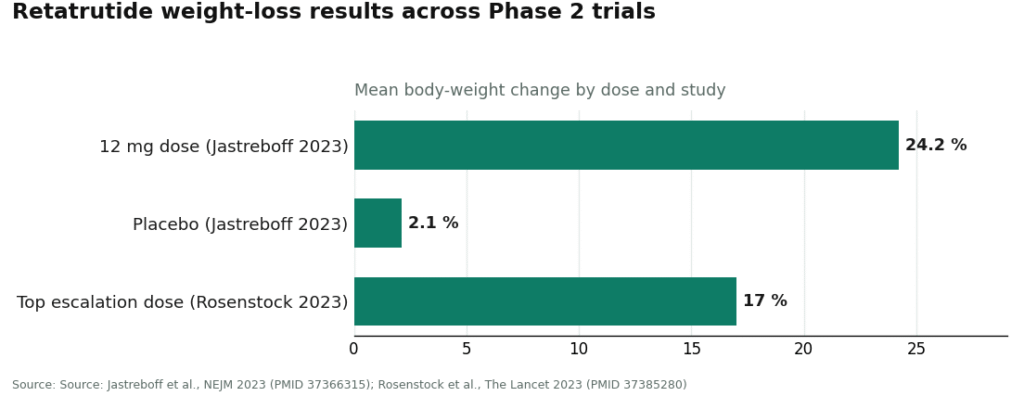
- Jastreboff AM, et al. Triple-hormone-receptor agonist retatrutide for obesity: a Phase 2 trial. New England Journal of Medicine, 2023. Reported ~24.2% mean body-weight loss at 48 weeks on the 12 mg dose vs 2.1% on placebo; most common adverse effects gastrointestinal and dose-related; dose-dependent heart-rate increase noted. PMID 37366315. https://pubmed.ncbi.nlm.nih.gov/37366315/
- Rosenstock J, et al. Retatrutide, a GIP, GLP-1 and glucagon receptor agonist, for people with type 2 diabetes: a randomised, double-blind, placebo- and active-controlled, parallel-group, Phase 2 trial. The Lancet, 2023. Reported ~2.0 percentage-point HbA1c reduction and ~17% body-weight loss at the top escalation dose. PMID 37385280. https://pubmed.ncbi.nlm.nih.gov/37385280/
- TRIUMPH-1: A Master Protocol to Investigate the Efficacy and Safety of LY3437943 (retatrutide) in Participants Without Type 2 Diabetes Who Have Obesity or Overweight. Phase 3, Eli Lilly and Company. ClinicalTrials.gov NCT05929066.
- U.S. Food and Drug Administration. Drugs@FDA: FDA-Approved Drugs database (retatrutide returns no approved listing; the agency has issued warning letters to firms marketing unapproved semaglutide, tirzepatide and related GLP-1 class compounds).